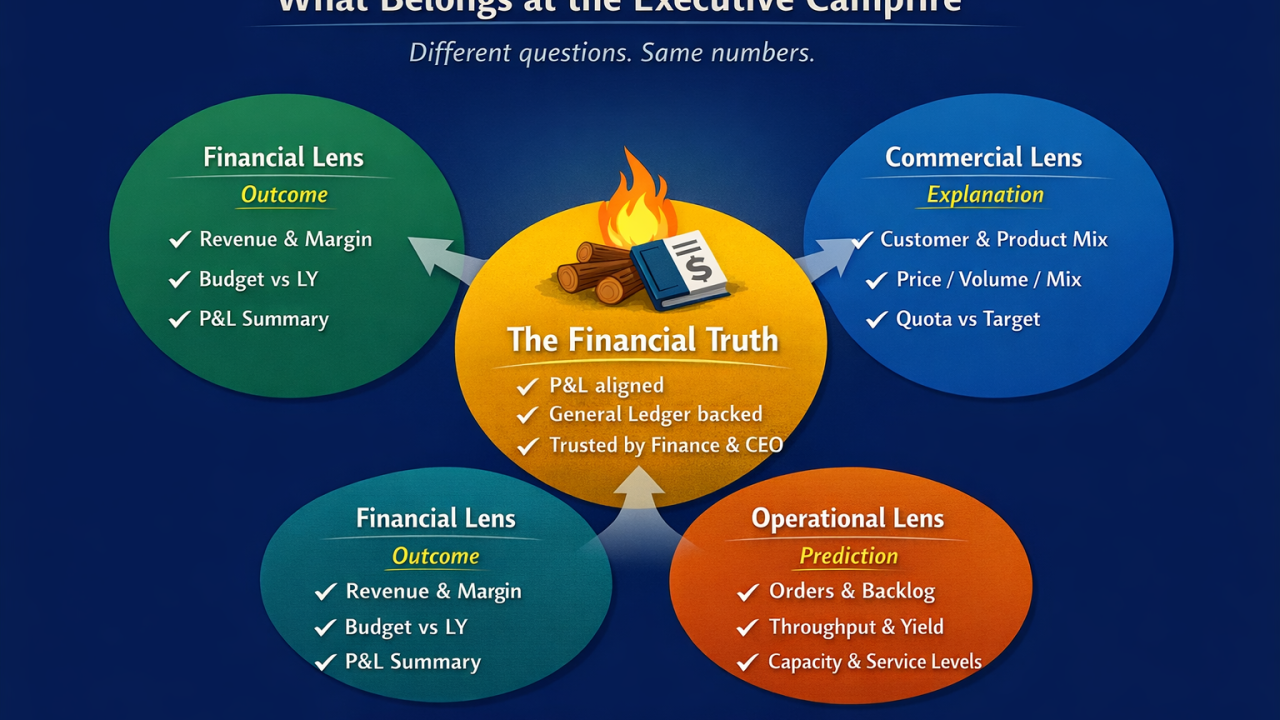
Most executive reporting problems aren’t caused by bad data. They’re caused by uncertainty about what should actually be discussed at the executive table. Lately I’ve been thinking about what genuinely belongs at the executive campfire.
Not what can be reported. Not what systems make easy. What leaders should genuinely gather around. Over the years, I’ve come to think of executive reporting as a campfire. Not because it’s cosy or informal, but because it’s the place where decision makers gather to align, to interpret what’s happening in the business, and to decide what to do next.
The campfire test
Every strong CEO I’ve worked with wants essentially the same thing from reporting. They want one place where the leadership team aligns. One set of numbers that everyone trusts. And no time wasted debating definitions. The campfire isn’t about detail. It’s about shared understanding. It’s about ensuring that when leaders sit down together, they are arguing about decisions, not reconciling numbers. Yet many organisations quietly undermine this by treating all reporting as if it belongs in the same forum.
The mistake: treating all reporting the same
Most reporting tension doesn’t come from bad data. It comes from using the right numbers in the wrong forum, for the wrong question. That’s how executive meetings slowly drift off course. Sales leaders find themselves defending results instead of explaining them. Finance teams spend their time reconciling rather than leading. Executive conversations descend into spreadsheets instead of decisions. None of this is inevitable. It’s usually a design failure, not a system failure.
One financial truth, viewed through different lenses
Well-run mid-market organisations tend to converge on a simple model: one financial truth, viewed through different leadership lenses. The mistake isn’t having multiple views. The mistake is failing to be explicit about which lens is being used — and why.
The financial lens: outcomes
At the heart of the executive campfire is the financial lens. This is where the organisation grounds itself in outcomes. Revenue, net of discounts. Gross margin. Variance versus budget and last year. These numbers must reconcile to the general ledger. They must align to the P&L. And they must be boring, stable, and trusted.
If this lens doesn’t tie, the fire never really gets lit. Everything else becomes noise.
The commercial lens: explanation
Once the outcome is clear, leaders naturally ask "why?". This is where the commercial lens comes in. Crucially, it is built off the same revenue number — not a parallel one. Here we explore customer and product mix, price versus volume effects, and sales effectiveness. Sales reporting doesn’t redefine revenue. It explains it. When this distinction is respected, commercial discussions become far more productive. Sales teams stop defending the number and start explaining the story behind it.
The operational lens: prediction
The best CEOs lean forward when the conversation turns operational. Orders and backlog. Service levels. Yield, waste, and throughput. Capacity constraints. These measures may not have hit the P&L yet, but they predict it. This is where leaders get early warning signals and the chance to intervene before financial outcomes are locked in.
A quiet but important distinction
One of the most common mistakes I see is mixing these lenses without saying so. Sales teams are measured against budget instead of quota. Financial periods are mixed with calendar months without clarity. Budgets are a financial control tool. Quotas are an execution tool. Periods exist to close books. Months and weeks exist to run the business. When these distinctions blur, reporting stops guiding behaviour and starts distorting it.
Good organisations don’t argue about which metric is “right.” They’re clear about which lens they’re using — and why.
What leaders lose patience with
Nothing erodes executive confidence faster than phrases like:
“That’s ops revenue, not finance revenue.” “It’s close enough.” “We’ll reconcile it offline.” Definitions that shift depending on who’s presenting.
These aren’t data problems. They’re design problems.
The quiet shift that changes everything
The most effective reporting uplifts don’t start with dashboards or tools. They start with a single decision:
We will be deliberate about what belongs at the executive campfire — and what doesn’t.
When that happens, meetings get shorter. Conversations get sharper. Reporting becomes an asset, not a negotiation.
The test I use now
I apply one simple rule to every report:
Does this belong at the executive campfire — or somewhere else? If it doesn’t help leaders make better decisions, faster, using numbers they trust, it probably doesn’t belong there. When leadership teams spend more time debating definitions than making decisions, it’s often a sign the issue isn’t data. It’s lens selection.
I’m always happy to compare notes with others thinking about this, particularly in manufacturing and mid-market businesses.