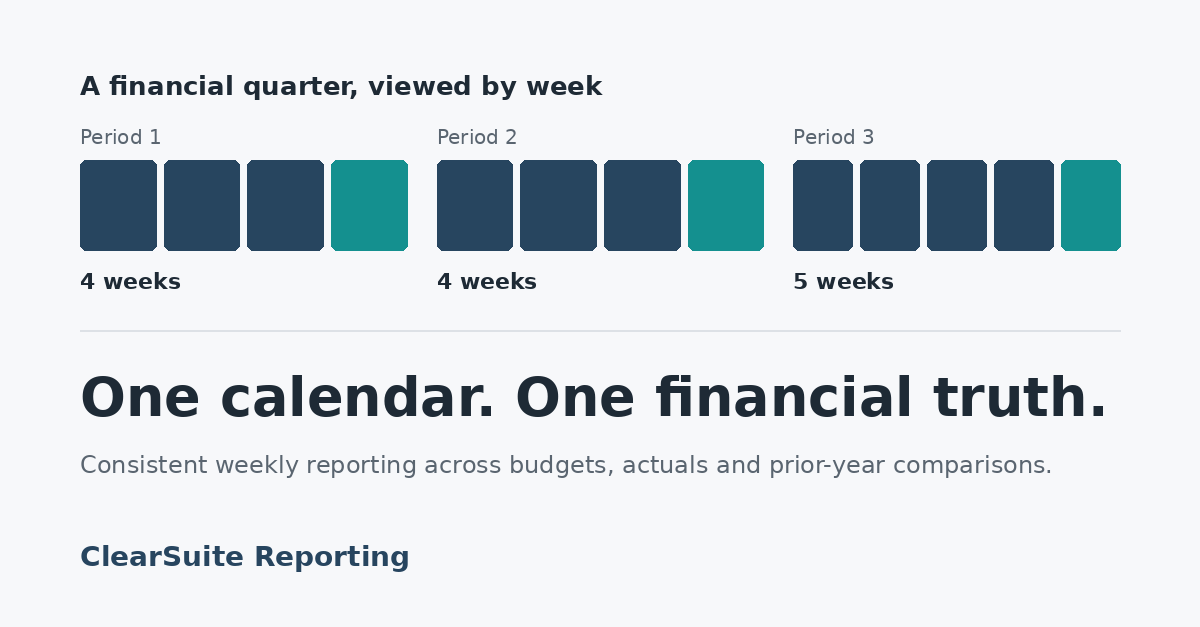
The short answer: NetSuite can hold a 4-4-5 fiscal calendar, but its accounting periods are built for posting and closing the books. They aren't built for weekly analysis. If you want trustworthy week-level reporting (budget vs actual by week, like-for-like prior-year weeks, a weekly management P&L), you need a reporting calendar that defines every week once and carries consistent financial meaning. Then every report works from that one definition, nobody has to rebuild it in a spreadsheet, and the weekly numbers can be checked back to the ledger.
I've worked in ERP for more than 23 years, and with NetSuite since 2009. Weekly reporting is one of the requests I see most often from retail, hospitality and food businesses. It's also one of the most underestimated, usually because it sounds like a formatting problem. It isn't.
Why don't standard NetSuite accounting periods handle weekly reporting well?
Accounting periods do one job: they control when transactions can post and when a period is closed. They do that job well.
A 4-4-5 calendar gives you periods of four, four and five weeks. That's useful for the close. But the week itself isn't a first-class object in a standard period structure. A week is just a range of transaction dates that someone has to work out.
So when someone asks for "sales by week", the report has to calculate the weeks on the fly. Every saved search, workbook or export ends up holding its own version of what a week is.
That's where things start to drift.
What problems does this cause for finance teams?
In my experience, it shows up in four ways.
Inconsistent week definitions
One report starts weeks on Monday. Another starts on Sunday. A third uses ISO week numbers, where week 1 is the week containing the first Thursday of January. That rule follows the calendar year, not your fiscal year, so ISO week 12 and fiscal week 12 are rarely the same seven days.
None of these is wrong on its own. The trouble comes when two of them land in the same meeting with different numbers.
Budget vs actual by week
Budgets usually sit in NetSuite at the period level. If the business manages by week, someone has to spread that budget across weeks. That's often an even split, which ignores trading patterns, public holidays and the five-week period.
The variance you end up with partly reflects how the budget was spread, not just how the business actually performed.
Prior-year comparisons on a like-for-like basis
Comparing week 12 this year to week 12 last year only works if both weeks cover comparable trading days. Calendar dates move. Easter moves.
Then there's the 53-week year. Most 4-4-5 calendars end on the same weekday each year, often the one nearest a fixed date. Fifty-two weeks is 364 days, so the year drifts and every five or six years catches up with a 53rd week, usually added to the final period.
If the 53rd week isn't handled deliberately, every comparison after it is out by a week. Most people don't notice until a number looks strange.
Management P&L by week
A weekly management P&L needs revenue, cost of sales and operating costs all mapped to the same week, and grouped into the same lines every time. When the week logic lives in each report, the P&L for the same week can come out differently depending on which report you open.
What does a reporting calendar layer actually do?
Here's my position: the week should be defined once, as data, not recalculated in every report.
A reporting calendar gives every week a single, agreed meaning that the whole business shares. It sits next to NetSuite's accounting periods, not in place of them. Periods still control posting and the close. The reporting calendar governs how you analyse the results for management reporting.
What matters is the financial meaning, not only the dates. Every week should answer the same questions, the same way, every time:
- Which fiscal period does this week roll up to?
- Which prior-year week is its like-for-like comparison?
- How should a period budget be phased into this week?
- Is this a standard week, a 53rd week, or a boundary week that straddles a calendar month-end or year-end?
Once those answers are agreed and governed, reports stop disagreeing about what a week is. That's not the same as reconciling. A calendar on its own doesn't make anything balance; the checks back to the ledger do that. But with the week settled, finance can spend its time on the variance, not on two versions of week 12.
What does good weekly reporting look like?
The detail varies from business to business, but in my experience the teams that get weekly reporting right hold to four principles.
- Consistent calendar definitions. The week start day, the 4-4-5 (or 4-5-4, or 5-4-4) pattern and the rule for the 53rd week are agreed up front, signed off by finance and operations, and never quietly reinterpreted by an individual report.
- Governed financial meaning. What a week rolls up to, what it compares against and how it's treated where it crosses a month-end or year-end are owned by finance and managed with the same care as the chart of accounts.
- Deliberate budget phasing. Period budgets are spread into weeks using a stated method that reflects how the business actually trades, such as prior-year weekly shape, rather than an even split.
- Reconciliation back to the ledger. Weekly totals are routinely checked against the period results in NetSuite, and any difference is explained. Without that check, nobody should trust the weekly numbers, however good the dashboard looks.
When all four hold, the outcomes are easy to recognise. The weekly management P&L reads the same whichever report you open, and it adds back to the books. Budget variances reflect performance rather than how the budget was spread. The 53-week year is handled by a rule, not discovered in a strange-looking number. And the weekly meeting moves from debating whose number is right to discussing what the number means.
At ClearSuite, this is the problem we built the CSR Financial Calendar and Weekly Facts to solve. They're reusable NetSuite financial reporting infrastructure, and they already run in production.
FAQ
Does NetSuite support 4-4-5 calendars?
Yes. NetSuite can set up fiscal calendars with 4-4-5 style periods. The gap is weekly analysis on top of those periods, not the periods themselves.
Can't I just use saved searches grouped by week?
You can, but each search holds its own week logic. That's fine for a one-off check. Once several reports depend on it, it leads to inconsistent numbers.
How do you handle a 53-week year?
Decide the rule in advance, record it in the calendar, and map the extra week explicitly in prior-year comparisons, whether that means comparing it with nothing, with the prior year's week 52, or leaving it out of like-for-like totals. Don't let everything after it quietly shift by a week.
Does a reporting calendar replace accounting periods?
No. Periods still govern posting and the close. The reporting calendar governs analysis. They work side by side.
Does a reporting calendar guarantee the numbers reconcile?
No. It removes the most common reason weekly reports disagree. Reconciliation still depends on governed definitions and regular checks back to the ledger.
Who should own the calendar?
Finance. It's a financial definition, so it should be governed like the chart of accounts.
The calendar is the boring part, which is exactly why it should be settled once rather than argued about every Monday. If your team is still reconciling different versions of "week 12", I'd be glad to compare notes on how you're handling it. You can find more about how we approach NetSuite reporting at clearsuitereporting.com.